
Product added to cart
Six of the Most Disputed Paintings in Art History
There are some paintings that, once completed, take on a life of their own. For any number of reasons, they become controversial, the subject of disputes that can carry on for decades — or even centuries. Whatever the cause, these paintings become not only artworks but also cultural artifacts around which stories, critiques, and arguments are woven.
1. Vase with Red Poppies, by Vincent van Gogh
When given to the Wadsworth Atheneum Museum in 1957, this painting was “believed” to have been by Vincent van Gogh. But Anne Parrish Titzell, who donated it, did not have a history as a collector and in 1976 a prominent art historian cast doubt on the painting’s origins. The museum decided to put it into storage. But in March of 2019, after the museum purchased state-of-the-art imaging equipment, the staff examined the painting and found what they thought were portions of a self-portrait of Van Gogh beneath Red Poppies. Forwarded to Van Gogh Museum in Amsterdam, it was further scrutinized and found to be authentic, dating to the period immediately after Van Gogh’s move to Paris in 1886. It was returned to the walls of the Hartford, Connecticut, museum in April of 2019.
2. Night Watch by Rembrandt van Rijn
First of all, this painting has come to be known by a false title, one attached to it nearly two centuries after it was painted in 1642. Originally entitled The Company of Captain Frans Banning Cocq and Lieutenant Willem van Ruytenhurch, the painting is not even a night scene. And a wealth of other lore has enveloped it. There are tales that it was so poorly received that it led to the downfall of Rembrandt’s career (there is little evidence that this is the case). A conspiracy theory posits that the large, complex painting has embedded in it the outlines of a murder plot against Rembrandt. Then there was its unlucky logistical fate. In 1715, when moved into the Amsterdam Town Hall, it was actually trimmed in order to fit between two columns in its new home. Two feet of canvas was taken from the top and left side (lopping off two figures), while several inches were cut from the bottom and right side.
3. Madame X by John Singer Sargent
This painting caused an uproar, in part over a detail that is not even part of the painting any longer. Undertaken at Sargent’s request, its subject is Madame Pierre Gautreau, a Louisiana-born Parisian socialite. It is a portrait that pushed the envelope of social norms by not only capturing the forceful nature of its female protagonist — but also leaving one strap of her gown slipping down over her shoulder. This caused such consternation amongst the social elite that Sargent repainted the strap into a more modest position to lessen its risqué reputation. He kept the painting in his possession for years until he sold it to the Metropolitan Museum, saying when the sale was finalized, "I suppose it is the best thing I have done."

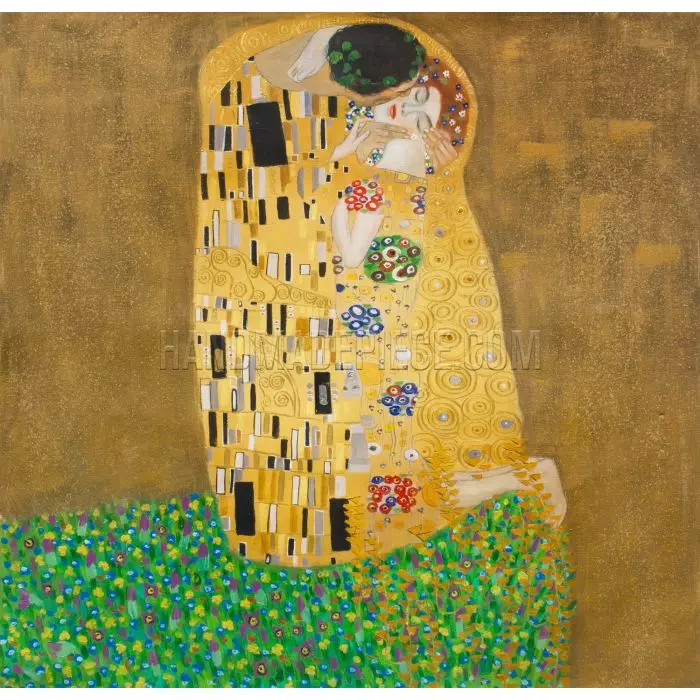
4. The Kiss by Gustav Klimt
Another artist who pushed societal norms around sexuality and nudity, Klimt painted The Kiss soon after his highly controversial Vienna Ceiling Paintings were labeled pornographic. His career took a hit, but The Kiss was warmly received — with the Österreichische Galerie Belvedere in Vienna buying it before it was even completed (and at a record-setting price). Although not as controversial as his earlier work, the gold theme of the painting harkens to the use of gold leaf in Christian art, which is provocative given the painting’s obvious theme of sexual passion.
5. The Grande Odalisque by Jean-Auguste-Dominique Ingres
This is a painting that was innovative, though not overly provocative, when delivered to Caroline Murat — the Queen of Naples and sister of Napoleon — after she commissioned it. But it has become more and more controversial in the modern era for its representations of traditional Western themes. One aspect that has come under scrutiny is the “editing” of the female body — the elongated spine, oddly proportioned legs, and clearly unnatural twisting pose — that foreshadows contemporary body augmentation and alluring poses. Finally, in 1989 the activist group The Guerrilla Girls used the painting in a poster — after replacing the woman’s head a gorilla’s — to provocatively ask, “Do Women Have To Be Naked to Get into the Met Museum?”.

6. Death of General Wolfe by Benjamin West
Although a highly stylized painting echoing Medieval Lamentation works that depict the lowering of Christ’s body from the cross, the painting was extremely controversial for its modernity — so much so that Britain’s King George III refused to purchase it. The issue was West’s using realistic clothing for the figures (as opposed to putting them in the classical garb of ancient Greece or Rome). Capturing a pivotal historical moment, the British victory on the Plains of Abraham at the 1759 Battle of Quebec, it is a painting that not only memorializes a hero’s death but also a political victory with far-reaching ramifications. At the time, such moments were expected to be enhanced by reference to classical culture. Instead, West goes for realism — including a Native American warrior representing the indigenous allies that the British Army depended on — that would be increasingly embraced by modern artists.
Categories: Art Introduction and Analysis
There are no comments yet