
Product added to cart
How Many Blue Colors Are Used in The Starry Night?
The Starry Night, with its dramatic colors, stands as Vincent van Gogh's most iconic painting. It garners endless praise from admirers who marvel at the intricate color details skillfully applied by Van Gogh on canvas.
The creation of The Starry Night took place after Van Gogh had arrived in Saint-Rémy, just before the onset of his mental illness. Filled with an unsettling sense of foreboding and a premonition of a somber future, Van Gogh embarked on painting this nocturnal masterpiece. Throughout the artwork, blue was prominently utilized to depict the night sky, influenced by varying levels of starlight. The hills and trees were also meticulously shaped with varying shades of blue. Upon counting, one can discern at least 21 distinct blue colors within the composition.
But why did Van Gogh employ such a profusion of blue? His choice was not solely to faithfully represent the inherent colors of the objects themselves; it was also a profound expression of his emotions. Blue, in this context, symbolized the melancholic atmosphere that enveloped Van Gogh's psyche during this period.
To delve further into Van Gogh's unique use of color, we have magnified seven images of The Starry Night, offering insights into his exclusive color scheme and artistic mastery.

The First Part of Blue Colors
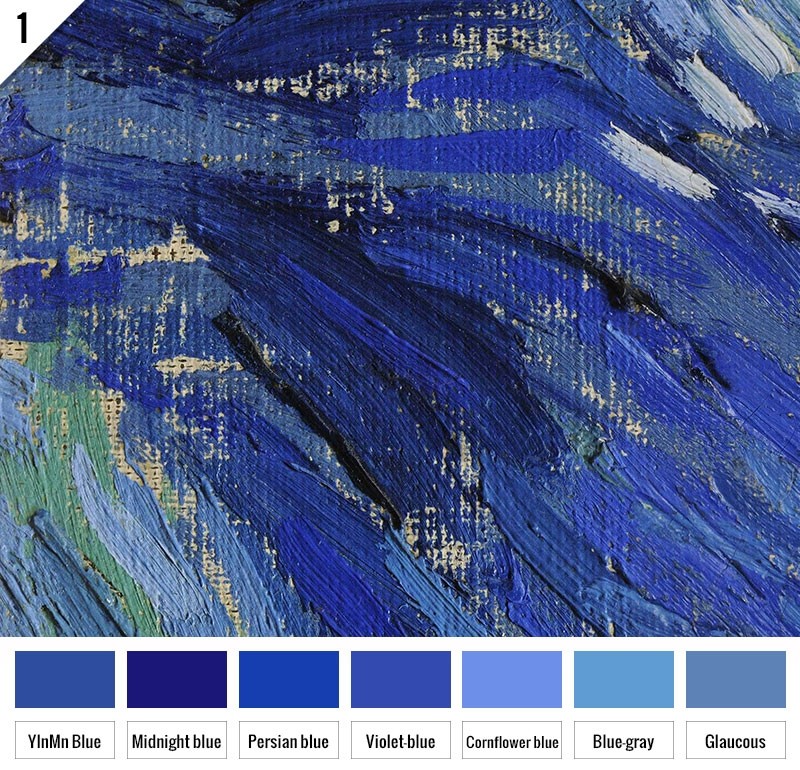
It is cut from the darkest part of night sky. The deepest blue is a mixed color of blue and black. This image mainly contains seven shades of blue colors, including YInMn blue, midnight blue, Persian blue, violet-blue, cornflower blue, blue-gray and Glaucous.
The Second Part of Blue Colors
Gray-toned blue is the major color of the second image. There are six shades of blue in the list: air superiority blue, ultramarine, Carolina blue, cornflower blue, blue-gray and Columbia blue.

The Third Part of Blue Colors
It contains the richest blue colors. The yellow stars shines in the sky and make various influence on the using of colors. There are nine shades of blue in this image. They are air force blue, air superiority blue, light blue, Carolina blue, powder blue, Byzantine blue, cornflower blue, Columbia blue and blue-gray.

The Fourth Part of Blue Colors
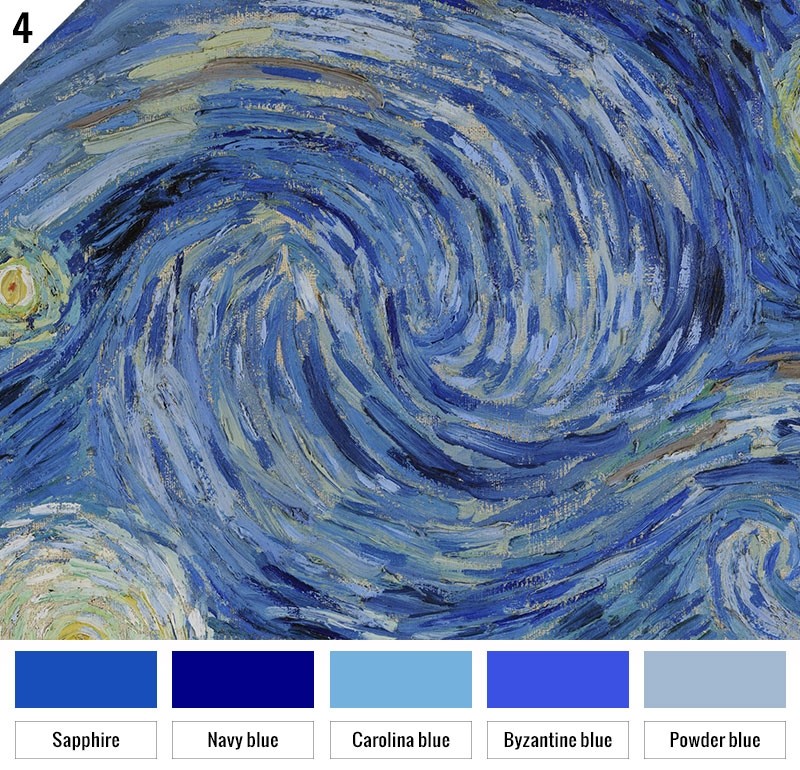
It is a symbolic whirlpool which includes deep and light blue. Sapphire, navy blue, Carolina blue, Byzantine blue and powder blue can be seen in this image.
The Fifth Part of Blue Colors
The color of the fifth is lighter than the previous. Carolina blue, air superiority blue, light blue, royal blue and cornflower blue are contained.

The Sixth Part of Blue Colors
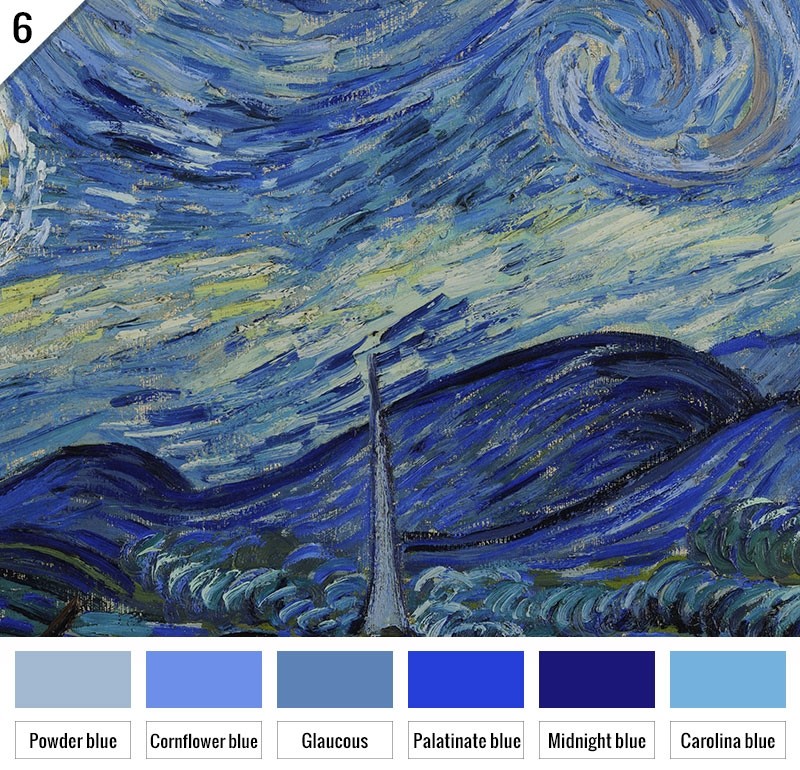
The hill was painted in blue. A line of mixing black and blue makes a clear boundary between the sky and ground. The using colors give a harmonious flavor. In this image, six shades of blue are included: powder blue, cornflower blue, glaucous, palatinate blue, midnight blue and Carolina blue.
The Seventh Part of Blue Colors
This part contains five shades of blue. They are royal blue, violet-blue, steel blue, federal blue and Byzantine blue.

Vincent van Gogh's "The Starry Night" masterfully employs a rich palette of at least 21 distinct shades of blue, not only to depict the scene but to convey his deep emotions. The prevalence of blue in the painting reflects his melancholic and uneasy state of mind during that period. Each part of the artwork reveals a carefully chosen spectrum of blues, showcasing Van Gogh's artistry in using color to express profound feelings and create an enduring masterpiece that resonates with audiences worldwide.
Categories: Art Introduction and Analysis
There are no comments yet